Sunday, 28 October 2012

What Labour Needs to do to Win the 'Disabled' Vote


Making rights a reality for disabled people


Introduction

Labour should take some credit for extending the rights of disabled people during its thirteen year tenure of office. Let's take a quick look at some of the positives introduced by Labour in the period 1997-2010:

  • Labour legislated to protect people who may be unable to make decisions for themselves, through the Mental Capacity Act which provides safeguards to help people make their own decisions about their daily lives and to be supported to do so where they need that.
  • In 2004 Labour gave new rights to disabled people through the Disability Discrimination Act, and has signed the UN Convention on the Rights of Persons with Disabilities. Removal of small employer exemption (for employers with less than 15 employees). One of the major changes was the removal of the small employer exemption which meant the DDA would apply to all employers irrespective of size including employment in private households.
  • Labour made families with disabled children a priority, with a total of £770 million in new funding for local authorities and primary care trusts to support disabled children and their families, to transform short break services, and to improve disabled children’s services and children’s palliative care.
  • Over the last decade the employment rate for working age disabled people has increased from 42 per cent to 47 per cent, with the gap between the rates for disabled people and the general working age population decreasing from 32 per cent to 26 per cent.
  • The Access to Work budget was increased from £15 million in 1994/95 to £69 million in 2008/09 and £81 million in 2009/10. Access to Work is likely to help around 35,000 disabled people take up or stay in work in 2009/10.
  • The introduction of free nationwide off-peak travel on local buses for the over-60s and eligible disabled people in England.
  • The establishment of the Equality and Human Rights Commission (EHRC) to act as a strong, independent champion to tackle discrimination and promote equality for all.

Without a doubt a good record. However, we know Labour could have done so much more during their three terms in government. Sadly, Labour become distracted; market forces and neo-liberal economics drove their political and then social agendas, allowing areas such as welfare to become soft targets for cuts. 

The Right to Work

By removing the small employer exemption, where employers of 15 or less employees could refuse to employ disabled people, Labour undoubtedly made it a bit easier for people with disabilities to gain employment. However, as the laws tightened so bosses, and human resource departments in larger concerns, conjured up more inventive ways of not employing disabled people.  

In March 2006 Bert Massie, the then Chair of the Disability Rights Commission, told a parliamentary inquiry into  Incapacity Benefit and the government’s Pathways to Work programme, that employers needed an 'attitude adjustment' towards recruiting disabled people. He went on to state that the green paper concentrated too heavily on the measures required to get disabled people back into work, without adequately addressing the responsibilities of employers to help bring that process about.
Tougher talking from Bert may have made more of an impression. Instead of adjusting the attitudes of employers who circumvent the law by not employing disabled people; why not toughen up the law, even making harsh examples of employers found guilty of discriminating against disabled job applicants.

Unless a future Labour government recognises that employers are discriminating against both disabled workers and job applicants, it will be business as usual.
Labour during its time in office wasted a small fortune on 'quick'-remedy, fast-track schemes for getting disabled people into work. For the most part these schemes were, and continue to be, a waste of money. They have proven to be expensive and open to corruption.

Instead of pouring millions into the bank accounts of private individuals, the government should use the resources that already exist. They are called Job Centre Plus. Given the right inward investment and support from the DWP JCP's can carry out the process of marrying-up job seekers with jobs.

Matching disabled people to suitable employers can offer greater challenges. Yet, the process is possible. JCP's will need to employ people who have both an understanding of disabled peoples' employment needs (which are as diverse as the group itself); and they would need to be able to empathise with disabled peoples' other, different, needs and capabilities. We cannot apply the one-size-fits-all attitude so commonplace amongst, especially, ministers from the DWP, past and most decidedly present.

Access to Work, regarded as the best kept secret in the DWP, is an invaluable resource that pays for itself, as for every £1 spent out on A2W somewhere in the region of £1.40 is recouped by the state - the gift that keeps on giving. And yet, in real terms this government is cutting back on Access to Work spending; that is the government is only reinvesting around 6% of the subsidy it will save from the Remploy closures and Residential Training Courses. It's like cooking the goose that lays the golden eggs...

Many within the disability movement agree that a scheme such as Access to Work is essential to offset those extra costs employing disabled workers may incur. Similarly, we also identify the extra costs incurred by disabled job seekers. Therefore, why not put in place an Access to Seeking Work scheme?

The idea that this government is making work worthwhile for disabled job seekers is simply a lie. Tax credits for low earning disable workers have been driven down in the past two years. For instance, the credit for those disabled people over 50 has been scrapped, so that some disabled people saw a £90-£100+ per week cut in their tax credits this year. Hardly an incentive for those to whom life is already a struggle.

Labour must do more for the disabled worker who, through no other reason than having a physical or mental impairment that limits their working week, is penalised. If, due to an impairment, someone cannot work fulltime they should not be financially worse off than their fulltime counterpart. Disabled people are faced with the same housing, travel, food, etc costs as other people; in fact, we usually face additional costs.

Of course Remploy was mismanaged. Just as British Rail endured decades of mismanagement and under resourcing, so it could be broken up and sold off; so Remploy experienced at least two decades of poor control and management from the board of directors to the highest reaches of senior management.

Sadly, Labour played a large part in the destruction of Remploy. For different reasons, I suspect to this government. Labour, rather than looking back to the very reasons for the creation of Remploy, and applying modern day approaches instead chose to listen to the politically correct brigade within the Party and indeed, on the Left.

For years the 'segregated employment' mantra played at conferences, at seminars, in papers, on blogs and at committees. The Left, adopting a Peter purist approach condemned 'sheltered' employment (they didn't have the decency to give Remploy and other subsidised schemes, there more accurate description of supported employment) as segregationist. Even sister trade unions, Unison, NUT and UCU, to name but a few, up until recently, chanted the segregationist mantra at Remploy.

Four-and-a-half years ago, the anti supported-employment wing of Labour and the Left got its way. In April 2008 thirty Remploy factories closed with the loss of some 2,500 disabled workers. Four-and-a-half years on, the Tory led coalition closed another twenty-seven. What made it easier was the fact that we had shown them the way a few years previously.

Will, on return to government in two-and-a-half years time, Labour reopen Remploy factories? I very much doubt they will. Such processes are rarely ever reversed. But, is there anything that Labour can do for the workers, betrayed in my view, by both governments?

The greatest thing Labour could do for ex-Remploy workers thrown onto the scrapheap, and for the countless other disabled people struggling to find work, is to ensure that the employment market is made completely accessible for people with disabilities. Labour should throw out the tried and failed job schemes, so identified by double counting jobs and the blatant fixing of success rates. In their place, within the safe and trusted Job Centres, train up adequate numbers of disability employment officers. While not an absolute prerequisite, perhaps look to take on and train people who have disabilities; people who have walked in our shoes, who understand the complexities of disabilities.

The Right to Live Independently

If Labour really believes that "...the government’s topdown cuts to disability benefits have been clumsy and badly thought through, with no account taken for how people actually live their lives.", then I fear they have learned nothing of the suffering disabled people are experiencing under this Tory-led regime.

Labour must either believe in the sanctity of the welfare state, and the right of disabled people to social security, or they will continue to be regarded as no better than the Tories by great swathes of disabled voters, their families and friends.

Yes, Labour did introduce ESA to replace Incapacity Benefit; and, Labour did roll out the, almost universally condemned, work capability assessment (WCA). These things Labour carried out in the face of massive opposition from disability groups and disabled people - those dependent on the benefit. Labour used experts such as David, now Lord, Freud to review welfare reform. This is a man so removed by privilege and wealth from the working classes that he joined the Tories in 2009, and now sits on their benches in the Lords. This man, Labour selected to look at a system that provides a safety net and security for ordinary people!

After more than two-and-a-half years in use the WCA has been condemned by the BMA (hardly a Leftist body) as 'callous' and causing 'distress'; calling for its ending “...with immediate effect and be replaced with a rigorous and safe system that does not cause unavoidable harm to some of the weakest and vulnerable in society.”

Not before time, last month, Labour's Liam Byrne called for a review of WCA. While defending the decision to implement the assessment, Labour will nevertheless call for a "fast and fundamental" review of the test that determines who is eligible for ESA acknowledging that the policy the party introduced while in government is not working.

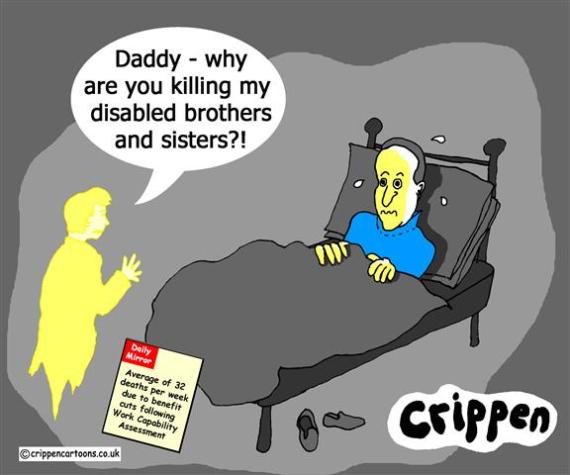
Come on Labour. The facts are staring you in the face. 32 deaths every week. £60 million per year wasted on appeals. Thousands of pages exist of testimony stressing the inherent unfairness of this flawed system. Condemn the WCA as a system not fit for purpose; and pledge its abolition when you return to power.

WCA must be replaced by a fairer and more transparent assessment. An assessment with realistic activity descriptors. The idea that if someone can press a button this somehow makes them 'fit' for work is both ridiculous, dangerous and downright  insulting. Disabled peoples' ability to work cannot be assessed by a one-size-fits-all computer programme operated by healthcare workers with an equally one-size-fit-all mentality to disability. No, a more sophisticated assessment that looks at the person in relation to their disabilities and the possibility of them working needs to be developed; and at some point in the process an adjudicator must have the authority to say, 'this person cannot reasonably expected to work'. 

Labour knows that often with disability come greater expenditure; for some as much as 24% on top of normal expenditure. Come winter and many of us are deciding can we afford to eat and heat our homes; it really can be that stark a choice. Disabled people are amongst the lowest earners in this country as well as being the poorest. Yet, when we shop we pay the same prices as everyone else - except when it comes to specialist items, which cost decidedly more.

There is no special queue at the petrol pump that gives preferential prices to disabled drivers; despite the fact we depend on our cars more than others. Our utility bills still need paying; and as some of us spend more time at home, these bills are greater than that of the average family. We also attract bills for things such as care and support, outlays not usually required by most other people.

This government knows we have these extra costs to meet. They also know the cost of rents, food and fuel are rising beyond the earnings and incomes of most disabled people. Armed with this knowledge they are still intent on introducing a new disability benefit, the Personal Independence Payment to replace DLA, that will take out 20% of recipients.

Changing from DLA to PIP is not as is claimed a fairer way to ascertain the validity of a person's claim for disability benefit. No, it is an ideologically motivated means to save money at the expense of those who can ill-afford the loss.

The people who gave us 'Reasonable Reform' (better known as the Spartacus Report) have put out another damning exposé which examines the costs to our economy over and above peoples' loss of benefit. 'Reversing from Recovery: The Hidden Economic Costs of Welfare Reform'. http://wearespartacus.org.uk/reversing-from-recovery-report/ reports:

  • 280,000 Motability customers set to lose their vehicles by 2016
  • More than 3,500 jobs lost to the economy
  • More than 30,000 car sales lost annually
  • A loss of £342 million GDP annually
  • Almost £80 million in lost taxes

But it isn't only industry that will take the hit. Thousands receiving current High Rate Mobility Component of DLA, who depend on a Motability vehicle to get them to and from work, shopping, and everyday living will be hit. For many their specially adapted vehicles are the only means of transport they can use.

Disabled people stripped of the Care Component of DLA will not be able to function properly.  For scores of thousands personal support is necessary for the basics of day-to-day living such as getting out of bed, toileting, bathing, dressing and cooking meals. Without this support many will be unable to work, as Access to Work only operates from front door to workplace and workplace to front door.

Once again the lies and hypocrisy of this government are exposed. Taking away vital personal care support from a disabled worker is not the action of a government that is seriously concerned for the well-being of disabled people, or helping us into or remaining in work.

Currently disabled people undergo a spate assessments for ESA, DLA, social care provision, ILF and Access to Work; eligibility for free wheelchairs, accessible housing, Freedom Passes, TaxiCard and Blue Badges can also be a postcode lottery.

Instead of undergoing several assessments for these benefits and resources there should be a universal assessment that covers the applicant for all benefits and resources. Unlike the Universal Credit live Pathfinder scheme planned to start in March or April 2012, we need in place a scheme that is not punitive, but rather offers applicants real social security.

It is clear that social care is an area that requires great consideration. On average, we are living longer today. Which is of course as a direct consequence of our NHS. Thus, improvements in medicine and medical treatment free at the point of delivery have produced a population that, on average, live well into old age; and of course, with longevity come age-related infirmity, illnesses and disability, for which greater numbers need personal care and support.

Labour must address the 'crisis' in social care for elderly and disabled people. Rather than taking the Condem route of slashing £1.3 billion from older people's care; or resorting to massive hikes in personal charges for care; or simply taking people out of care provision by changing the eligibility criteria, Labour should fall back on its tried and trusted 'problem' solving, and create a National Care Service to be run on the same principles of the NHS, which is to provide care free at the point of delivery.

While Dilnott's proposals place the onus on individuals contributing towards their social care; this is no more than another tax on the poor, just as with taxes such as the congestion charge and VAT, those at the bottom are always hit hardest.

Working class people have already to find extra money to pay towards less generous money purchase pensions; higher costs of housing; fuel costs that are spiralling out of control; with unprecedented food rises; while undergoing wage freezes, for several years in many sectors. Can the state then seriously expect an underpaid, often debt-ridden, workforce to find more money to fund their care in old age!   

Care packages and disability benefits must be made more portable. People in receipt of care packages should not fear being reassessed downwards because they move from one geographical location to another.

Similarly, disabled people who move home or into the workplace should not have to undergo repeated reviews of DLA. Moving home or getting a job should not put disabled people under undue pressure wondering if doing the right thing is actually doing the right thing.

If cross party agreement isn't forthcoming on the future of social care, then we must make brave decisions, as our predecessors did in 1945, when against the will of the opposition parties and vested interest within the health profession they went ahead and started our NHS.

The Right to a Roof Over Your Head

Speaking to people who work in the advice sector, especially those who advise on benefit uptake, there is a real sense of foreboding with regards to the new Universal Credit, which will be piloted starting March or April 2013. I've been told by such experts in the field that we are sleepwalking into what could be the most socially damaging changes to the benefits system ever.

The rules will change, so that people of working age living in social rented properties will see housing benefit linked to the size of the property it is felt they need. Therefore, a couple living in a two bedroom flat could be penalised by £13 per week; and this 'room tax' would increase with the amount of 'extra' rooms in the property.

Disabled people will be hit by the new caps on housing benefit. As many as 11,000 young disabled people, those under 25, could be left homeless. Many people with disabilities will have to leave the areas in which they live; thus losing support networks made up of family and friends.

If forced to move long distances from their support networks, people will turn to social services in ever greater numbers seeking support and care. Those who aren't in a position to properly fend for themselves could end up in hospital, their conditions worsened due to a lack of decent care provision.

Some facts on disabled people and housing:

  • Disabled people are more likely than non-disabled people to live in poor housing. There is a clear shortage of housing that is specifically designed to meet disabled people’s needs. 
  • Disabled people are twice as likely as non-disabled people to be social housing tenants.
  • In 2007-08 over 6 million households contained at least one person with a disability or serious medical condition. Of those 6 million people, there were 1.5 million individuals in England who required specially adapted accommodation because of a ‘disability or medical condition’.
  • There are approximately 4.5 million households which include one or more people with a reported mobility problem. The majority of those people are aged 60 years and above.
  • Suitable accessible housing is required for people with mobility problems, who may find that their current accommodation limits their independence and social life as well as presenting increased safety hazards. 
  • 1 in 5 disabled people requiring adaptations to their home believe that their accommodation is not suitable. 
  • Although the gap in non-decent accommodation has narrowed over recent years, 1 in 3 households with a disabled person still live in non-decent accommodation.
  • Less than a third of people with a learning disability have some choice of who they live with, and less than half have some choice over where they live. 
  • At least half of all adults with a learning disability live in the family home - meaning that many don't get the same chances as other people to gain independence, learn key skills and make choices about their own lives. 
  • Around a third of all disabled adults aged 25 to retirement ago are living in low-income households. This is twice the rate of that for non-disabled adults.
  • Children and older people tend to be more at risk from poor housing conditions in terms of their health and safety.
  • 53% of disabled children under the age of 15 live in unsuitable accommodation.


These facts and figures demonstrate the very real need for a massive government investment in council, mixed social landlord and affordable 'to buy' housing across the country.

Back in 2007 Gordon Brown made a commitment to a £1.5 billion social housing, in order to provide housing for families on low incomes and on council housing lists. Labour will need to resurrect such a programme, but on a larger scale.

The Tories have recently 'relaxed' section 106 rules, thus giving house builders an 'affordable housing holiday'. Remember the 'pensions holidays' enjoyed by bosses in the 1990s that saw companies stopping their pension contributions to occupational schemes; and just how these have come back to haunt us? I predict similar disasters occurring in housing.

However, Labour can change this. It is imperative that Labour has a progressive social housing programme. No. Make that council housing policy to regenerate house building in the UK.

Meanwhile, Labour council authorities can alleviate the dire housing shortages experienced by disabled people. Currently too many councils and social landlords do not have up-to-date registers of their housing stock that identify mobility or wheelchair accessible properties. All too often when such properties become vacant the landlord's builders enter the premises and remove all access fixtures and facilities. Stair lifts are removed; wet rooms ripped out and replaced with, often, inaccessible baths or shower units. What a waste!

There is an urgent need for social landlords, including councils, to first identify properties that are mobility and wheelchair accessible; and second, to ring fence such housing for disabled tenants use only.

Finally, getting on to and negotiating council housing lists are becoming increasingly Byzantium and tortuous. A simplified and fairer scheme needs to be formulated and applied universally.

The Right to a Family Life

The concept of a universal credit is one that has been around a long time. Politicians, social commentators and people working in the benefits industry have all criticised our system as being unwieldy and over complicated. Each year billions of pounds in benefit goes unclaimed.

Of course, it took a Tory-led government to finally introduce a Universal Credit (benefits) scheme; but of course, it is a system that plays to the lowest common denominator. Rather than formulating a structure that would guide a claimant through a logical system whereby with a minimum of bureaucracy  they end up receiving their full and fair entitlement; this government has introduced a punitive credit system that penalises disabled people, children, job seekers as well as people in paid employment.

Aside from the rich and those in well paid jobs, almost all others will feel the pinch of Universal Benefits. So, a bus driver with a family, earning £27,000 per annum and living in privately rented house, subsidised by housing benefit, could be forced out of his home due to a cap on housing benefit.

The Condem's are aiming to slash by half, from £54 to £27 per week, the Child Tax Credit paid out to households with disabled children. Thus throwing scores of thousands of families into poverty; as well as forcing greater levels of social exclusion on disabled children.
We, that is the Labour Party, should have no difficulties in doing the right thing here. This policy must be amongst the first pieces of business that we engage in once back in control. A clear unambivalent commitment has to be made by us; that we will protect those most in need of social and financial security in our society.

A Universal Credit fit-for-purpose should be introduced. A system that eradicates the need to fill out reams of forms. A system that is understandable to the end user that logically links benefits together. A system that is designed to help claimants not in place as a punishment.

The Right to a Life Free of Fear

For thirteen years I witnessed a Labour government in power who pandered to the excesses of the scum press. Tony Blair's unholy pact with the Murdoch empire before and after his elevation to Number 10 is a mark of shame that will remain on the name of Labour for many years to come.

During those years the likes of Darling, Blunkett, Hain and Purnell while heading the DWP engaged in the vilification and demonization of disabled people. Often going to such extremes as feeding the right-wing press with propaganda which was then printed unfairly showing disabled benefits claimants as cheats and fraudsters.

There are thousands of disabled who today feel a deep antipathy to the Labour governments of 1997-2010, and by association to the Labour Party of today - especially when we Ed Balls gets up on a platform and tells us there are still hard cuts to be made; and welfare reform will take a massive hit when Labour return to government.

Unsurprisingly, when given the press received by disabled people disability hate crime has been on the increase in recent years. Disabled people report naked hostility directed at them in the streets, often in the form of verbal abuse, less so by physical violence - though this aspect of DHC is on the increase.

It is hardly surprising that we, disabled people, as a group within society are experiencing such anti-social and criminal behaviour given we have a government that allows its influential members to publicly blame disabled people for the fiscal deficit, brought about by casino banking practices encouraged by get-rich-quick neo-lib free market speculation. When ill-informed members of our society are spoon fed lies about disabled people receiving new cars; when ATOS carries out assessments on disabled benefits' claimants that are purposely skewed to throw up erroneous and misleading results; and, when the DWP takes this flawed data and offers it up to an overly compliant press as the truth; this further adds to the scapegoating of disabled people.

However, there are also other factors in play when it comes to DHC. One factor is better integration of disabled people into mainstream; whether this is through employment or the opening up of society, a greater understanding and acceptance by the general public on the whole. 

Greater exposure by disabled people to the wider society also leaves us more vulnerable to the less tolerant within our communities. The kind that will always endeavour to prey on those they perceive as weak and easy targets.

Much debate has been generated within the disabled community and amongst those in the police and crown prosecution service as to whether we are living through a period of exceptionally high crime against disabled people, or is it because the reporting mechanisms are easier to access. While there is, for instance, a greater incidence of reporting DHC in Leicestershire, than the Met in London experiences; it is widely recognised by all parties that that disabled people reporting harassment and bullying are beginning to be taken more seriously by the police - though some forces are more progressive than others.

Whether it is low level incidence of name calling or it is physical attacks on the disabled person, Labour must send out a message that DHC is unacceptable in any form. Labour, working with police forces up and down the country should ensure that proper procedures are in place for disabled people to easily access. Disabled people should feel safe in reporting incidents of DHC.

Labour in government cannot repeat the disgraceful behaviour of Iain Duncan Smith, nor indeed its own ministers such as Darling, Hain, Purnell and co, who are, and were, complicit in the demonization and vilification of disabled people to an extent that caused the rise in hate crimes against a group of people whose only crime is their inability to surmount barriers put in place by society.

Friday, 5 October 2012

Let's Rise Up Against Universal Credits

A friend of mine, and a disability campaigner of long standing, Bob Williams-Findlay, put the following question on Facebook today: "Do people really believe that the public will turn against the Government's introduction of PIP if we employ the same degrading language of our oppressors?"

PIP will not in itself drive the multitudes to mass protest. However, Universal Credits is quite another thing. We are already hearing about the early effects of this change in the way welfare benefits are to be administered. The plight of Counihan family in Brent is an early indication of how the housing benefit trap will impact on ordinary working people.  https://www.facebook.com/vincent.counihan.1?fref=ts
When people reach the cap ceiling of £500 per week (for families) and £350 for single people; when they are hit with bedroom taxes they cannot afford; and evictions begin on an industrial level will working people begin to stir.

A friend of mine likened what this government's policy of benefits' capping, especially in and around housing benefit, a modern day Highland clearance scheme. Pushing working class poor out of the centre and inner city areas to wherever rents are cheap enough for them to settle.

London could end up like Paris, with all the social housing on the periphery, probably outside the M25; and workers having to commute in and out to work every day. Of course, London is 5 times the size of Paris, so travelling will be a greater problem.

The only way we will punish this government is by creating our own Poll Tax moment. Universal Credits have the ingredients to build a massive campaign. As with most of what this government proposes and introduces, at the expense of the masses, this particular programme of misery reaches across far more different groupings of people.

Up to now the Tory attack dog press has happily propagated the lies and half-truths put out by the government. After all, many of the welfare cuts hit groups, such as disabled people and young unemployed, who had already been softened up by years of demonization; thus, we were fair game. The sooner the feckless fripples came off the gold plated benefits they'd grown so accustomed to, the better.

But now, the bite is going to be on working and non-working people alike. No matter how pious the Daily Hate and Sun are when castigating welfare scroungers; it will not be quite so easy to attack families the heads of which are working, but still depend on tax credits and housing benefit.

Come on, let's get Universal Credits working for us!


Friday, 28 September 2012

The Failings of Capitalism


Looking for an easy to digest and take in explanation of the crisis in capitalism? 

Then watch this video produced by RSA Animate, with renowned academic David Harvey, along with some very clever cartoons, questioning whether capitalism has had its day and why a system that is responsible, just and humane cannot take its place.

Tuesday, 25 September 2012

ATOS is a Capitalist Organisation First and Foremost

French, British, American, Japanese, Chinese...
who actually cares?
Reader, what has ATOS being a French company got to do with anything? Would we feel better about ATOS if it was British, or American? ATOS is a capitalist organisation, which means its first and last loyalty is to its profit margin. Using French imagery to denigrate ATOS is a distraction.


What point is being made by associating ATOS with French-ness? As we are aware, ATOS is now identified by a great many in a negative light. Indeed, up to recently if you Googled ATOS healthcare the first site that came up was 'ATOS Kills'!


When I come before ATOS either for the WCA, if I lose my job, or for a PIP medical sometime in the near future, I will not be measuring ATOS' incompetence and greed in national terms; as I doubt do the scores of thousands who ATOS continues to fail.


Let's condemn, attack and beat ATOS on its failings to disabled people, not on some simplistic national connection.   

Monday, 24 September 2012

Trespassing Scum versus Elitist Yahoos

A group of anti-tax dodging activists decide to hold an impromptu award ceremony to coincide with a big thank you bash arranged by the filthy rich for the even filthier former head of HMRC, Dave Hartnett.

Hartnett during his tenure as top honcho at HMRC, or the tax office to the rest of us, showed great generosity to the likes of Vodaphone, Goldman Sachs, to name but a couple. Letting Vodaphone off paying a whopping £8 billion!

The group, who go by the name of 'We are the intruders', looked and sounded the part, togged up in black tie with crystal cut accents. However, as their praises for the friend-to-the-filthy-rich became more blatant, so a couple of the cannier diners cottoned on; with one particularly nasty gobshite threatening to set the dogs on them. Another spat out 'trespassing scum' - probably works near St Pauls and gets his rocks off at weekends watching foxes torn to pieces by a pack of hounds.

Trespassing scum? As opposed to tax-dodging-child-starving-youth-aspiration-stealing-disabled-benefits-robbing-NHS-closing-welfare-state-smashing bastards...

Give me the trespassing scum every time.

It is great to see the great and the good in their true light; how exactly they view the rest of us, the 99%, who aren't multi millionaires.

Last week we had the government's Chief Whip, Andrew Mitchell, calling police officers, who guard Downing Street, 'fucking plebs' (this a few days after two women police officers were brutally murdered in Manchester) because he was asked to a use a side gate, an exit more convenient both for the officers involved and security purposes.

In many ways I am pleased that the dinner guest at the HMRC boss's leaving party and his close relation, Mitchell, are speaking in this way about those they perceive to be inferior. The more the merrier. Let's have more accusations of pleb and scum directed at us. Hopefully they'll broaden out, 'chavs', low-life, working class drudges, riff-raff, rubbish, detritus, shit...maybe, sub-human.

The more the privileged open their mouths and minds in our direction the greater the opposition to them will become. The working classes will only tolerate this kind of abuse for so long. Cameron and his cadre of millionaire and billionaire Bullingdon Club Yahoos are an anachronism; one which we should have done away with decades ago. 

Thursday, 20 September 2012

KELVIN MACKENZIE DOORSTEPPED BY CHANNEL 4 NEWS OVER HILLSBOROUGH


I agree with all the descriptions of McKenzie penned on many blogs and emanating from the mouths of decent people everywhere, but especially women and men from Liverpool. The man is a disgrace to humanity.

However, aren't the tactics used by Alex Thompson exactly the same as those used by Scum reporters. That McKenzie is a bully there is no doubt. In fact he reacted the way most bullies do when the balance of power is switched; that is he tried to run (drive) away from the threat.

If an outsider watched the video clip without any sound, the good guy could very easily be mistaken for a bully himself.

My point is that the Sun, Mail, et al are the real bullies. Whether it is misreporting, through hateful lies, the circumstances the deaths of the 96 people at Hillsborough, and in doing so smashing through the grief of thousands; or demonising disabled people to such an extent we are experiencing unprecedented levels of violence, this is their modus operandi.

Channel 4 is a decent media organisation; it does not need to resort to door-stepping scum like McKenzie. Let's leave those kind of reporting tyactics to the likes of McKenzie and his acolytes.     

Sunday, 16 September 2012

The Glory of Sport

Single leg amputees playing football on a beach
in Sierra Leone

Not for these young men the splendour or glory of the Paralympics. No TV cameras projecting their feats across the globe; no stadiums full of appreciative supporters cheering on their sporting endeavours. 

These are the single leg amputee footballers of Sierra Leone. Years of civil wars have left a stark legacy in this West African country. Scores of thousands of people disabled, mainly, as a result of land mines indiscriminately seeded around the countryside.

This picture put the whole Paralympic and Olympic Games, bread and circuses into perspective for me. 


Saturday, 15 September 2012

Unconditional Love

Ordinarily I avoid feel good stories, especially were animals are involved. However, when I saw the captions below on Facebook my heart melted. Lily, was blinded by a bizarre medical condition; and Madison has become her sight. A true case of unconditional love and kindness.

Lily and Madison are inseperable

Thursday, 6 September 2012

Stop Using the Medical Model as a Blunt Instrument


“The easiest way to check for cheats is to check hospital records for continued attendance to a consultant, pain clinic or whatever the persons disability and their respctive hospital department the cheat wont have these records will they as they will never have attended ,”

The above statement was taken from a response to an article on: "Free Conference – Outsourcing and Austerity: Civil Society and the Coalition Government" on the Hardest Hit Website, and in my view is a very ‘medical model’ take on disability, presupposing that ‘genuine’ disability can only be measured by medical means; as though medicine has all the answers to disability.

There are lots of conditions that don’t necessarily respond to medical treatment; or can be treated by routine visits to a GP. If a person has a condition that has stabilised or reached a point where medical intervention, at consultant and hospital level, is no longer required, then what is the point of them visiting hospital?

Many disabled people get on with their lives without a continuous round of consultant appointments, visits to clinics or respective hospital departments. A person does not have to be perpetually ‘under’ a consultant to qualify as disabled or indeed to qualify for benefits such as DLA.

Regular visits to a GP can keep people abreast of the medical side of their conditions. If and when conditions worsen the GP can then refer the person to a hospital consultant.

Conflating the issues of a need for medical intervention with the needs of disabled people only serves to reinforce the medicalization of disability and does not recognise the fact that disability cannot be measured in medical terms alone.


Monday, 20 August 2012

Facebook court ruling: What you share on Facebook is admissible as evidence

Remember when posting to Facebook, it is a public site read by other people, including the authorities!
Just a thought, but maybe circumspection is the best policy when posting across the ether. I love the way the piece opens in YTech:


"Did you know that what you say on Facebook can be used against you in a court of law? If you're sharing something with your friends, you may as well be sharing directly with the judge and jury:"

As though you're going to be dragged before the beak for LOLing at a mates dodgy photo; or have Lily law kicking your door down at dawn because you OMGed at a nasty story from the Daily Fail.

No, what has occurred here is an Internet eejit has threatened others online as well as boasting about violent acts he has committed. Jesus Christ, the man's a fucking moron, a liability to himself.

Keyboard heroes. Little people with egos the size of elephants who can't get it on in the real world think it is ok to act like gangsters on the internet.

Thursday, 16 August 2012

Net the minnows: But also go after the whales

Oh dear, what a rogue's gallery of ne'er-do-wells, mountebanks, cutpurses, blaggards and rascals that the scum press have dug up for our delectation. 

Great, now they have identified these minnows why not seriously take on the big boys

Exchequer secretary David Gauke, said: "The government is absolutely committed to tackling tax evasion and fraud.

"These criminals have collectively cost the taxpayer over £765m and HMRC will pursue them relentlessly."

Quite right to set up a hue and cry against this assorted bunch of ciggy smugglers, illegal baccy producers, rum runners and allied trades. What sort of a country are we that allows such flagrant criminality to flourish without the full weight of the law to come crashing down to smash it from existence.

Well, we're the sort of hypercritical, two-faced, duplicitous, class-ridden shit house of a country where the scum press in connivance with a scummier government appoints itself judge, jury and executioner when dealing with common criminals such as the twenty exposed in papers today; yet, this same shower of self-important bumptious disgraces to the press fail to raise their voices with quite the same indignation when presented with the real tax cheats and frauds that cost this country not a poxy £¾ of a billion, but somewhere in the region of £120 billion every year.

So, scum press of the UK, fuck the small fry. Why don't you expose the big boys. The rats that deprive our kids of a decent education; the scum that cause our hospitals to close; the filth who are to blame for disabled and elderly people being denied proper care.

Why not shame:      

Philip Green for dodging personal tax bills of almost £300 million?

Vodaphone who were let off a whopping bill of £4.8 billion?

George Osborne who has the audacity to smash our Welfare State on the grounds of deficit while dodges £1.6 million in personal taxes?

Barclay's bank who were ordered to pay HMRC over £500 million in avoided taxes?

The PM himself, whose own father was one of the first to use 'off-shoring' to cheat on his taxes. Indeed that's where Cameron's own wealth stems from.

Sure, go after the 20 they have in their sights. But, don't take the piss and leave the big fish to swim safely to their off-shore tax havens.


Tuesday, 14 August 2012

Remploy's Final Chapter


Years ago I worked in the Remploy factory in Brixton. Tucked away off the main road a short distance from Brixton Town centre it stood in its own yard a 1960s build one-storey factory abutting a two-floor office building; much like any other light industrial unit in any of thousands of yards up and down the UK.

Indeed the similarity didn't end there; for once you pushed open the factory doors you entered into a veritable hive of industry. Casting an eye around the open-plan factory you'd have seen several production lines employing 30 or 40 people; while others sat or stood at individual workstations carrying out tasks such as soldering, complex wiring operations and testing of delicate computer boards and cards.

Bells would sound; signalling to small groups of workers break times. Off they'd traipse to a canteen at the far end of the shop floor, chatting to one and other; some engaging in horse-play, laughing and calling out to mates across the factory divide.

This toing and froing, hustle and bustle sound-tracked by the thrumming of tools, laughter and banter was the very theatre and music of industry.

However, this was a Remploy factory; and while replicating the average light-industrial workplace found in any city, town or edge of town industrial estate anywhere in the UK, there was one difference...all the shop floor staff and many of the white coats, indeed, were disabled.


In 1945 Britain had experienced six long and hard years in a state of war; now she was ready for a welfare state; and so Remploy was born. A company that employed disabled people giving them meaningful employment in a safe organised working environment.

From its first factory in 1945 at Bridgend, making violins, Remploy would over the years spread across Britain growing to over 10,000 factory employees in 84 sites.

So, what went wrong?

Thatcher and neo-liberalism is part of the problem; and, a lack of understanding of Remploy and disabled workers' choice, especially by the Left, and in particular by the purists within the disability movement, both contributed to the demise of Remploy factories.

Even six years ago when Europe eased public contract procurement regulations for supported employers, Remploy's board of directors sat on their hands. Instead of fighting for these contracts they made no effort; never bringing in more than around 20% of public contract work.

Then the axe came to drop; and 4½ years ago, to their everlasting shame, a Labour government began the mass closure of Remploy factories - 30 closed in March 2008.

A survey carried out, earlier this year, amongst the 2,500 Remploy workers who took redundancy in 2008 pointed to 85% of them no longer in full-time employment. The Class of 2012 can expect to fare far worse.

As an ex-Remploy worker and Branch Secretary (from 1996 to 2012) I have been involved with my Branch and membership in struggles to keep factories open since 1999. In that time my Comrades, from within and without Remploy, have tirelessly fought and supported the concept of disabled workers' choice.

In the last Campaign, beginning in 2007 and ending in 2008, the trade unions threw all their political and organisational weight behind the Remploy Campaign. Unite (still in its component Amicus and T&G state), the GMB and Community produced an alternative business plan; we embarked on a Remploy Crusade touring the country Remploy factory site by factory site.

I criss-crossed Britain with other Unite Branch activists attending rallies and demos in England, Scotland and Wales; yet, despite our efforts the factories closed.

Four years on the war recommenced. This time the government went right to the heart of the established disability movement and handed a purse of silver to Liz Sayce, then the CEO of RADAR (an organisation along with others that had helped stab us in the back in 2007), to supply them with a report on disability employment support.

Sayce played up to the gallery, just as her paymasters expected. She condemned both Remploy and residential training courses as too costly while recommending Access to Work to the government.

What you won't find within the pages of Sayce's partial findings is the true feelings of thousands of Remploy workers who she chose to ignore; instead she cited the views of the minority whose agenda chimed with her own.

Needless to say, Liz Sayce's reputation within the disability movement, as well as that of her new organisation (DRUK) who are still vociferously backing the government's closure programme, is much damaged. 

Fast forward to today. Despite a number of strikes across almost all Remploy factories; despite thousands of letters written to MPs, ministers, councillors and politicians of every stripe and stature by workers, their families, friends and supporters; despite bill-boards attacking this disgraceful action; despite a 100,000 signature petition handed into the PM; despite the double-dip recession with its attendant hardships of cuts and mass unemployment (most yet to happen); despite all these actions, this stony-hearted government, which seeks solace in its ideology, refuses to budge from destroying the jobs, hopes and aspirations of 1,518 disabled Remploy workers.

Comrades in Remploy, the fight goes on, as it must. Unite remains steadfastly behind your cause. If your factories close in the next few weeks it will not be from the want of effort from you and the trade unions, Unite, GMB and Community.    

Monday, 13 August 2012

"PLEDGE: Stop The Government From Taking Benefits From The Truly Disabled"


I have some very deep reservations with the above statement. While politically and morally supporting the fight against this government's onslaught on disabled people's benefits and rights, I take issue with the term 'The Truly Disabled'.

Here are the 'Truly' Disabled. Those 'Worthy' of our Respect.
Terms such as this only serve to bolster a view of deserving and undeserving disabled people; a view all too readily subscribed to by the right and, sadly, other working people looking for scapegoats.

A constant drip-feeding of stories in the Daily Fail, and other scum rags, about people fraudulently claiming disability benefits has captured the imaginations of all too many people who are willing to believe the worst in all of us. So much so that the incidence and reporting of disability hate crime is at an all time high.

People with visible disabilities are being challenged by strangers as to the veracity of their conditions. Strangers are shouting abuse at disabled in the street. Vision impaired men and women are being told that they are putting it on, that there is nothing wrong with their sight.

Very soon the distinctions between the worthy (or truly) disabled people will be brought into high relief through the Paralympics. Those doughty women and men giving it their all for Team GB will be applauded and lauded for bringing glory to the country - and good for all Paralympians from across the globe.

Disabled people fighting against ATOS will be compared with the brave disabled athletes who despite adversity are making a go at things instead of complaining about loss of benefits. Stories and issues will become conflated; and once again we'll hear of the truly disabled and the worthy disabled, as opposed to the rest of us benefits' claiming fripples.

Sunday, 5 August 2012

Back of a Stamp or a Library...


A wag on Facebook posted the picture below, with the legend "Hey cool, the library on how to understand women"

Women are of such variety complexity and profundity of nature that it takes a library, as above to house the writings thereof

Preferable, I'd say to have enough depth and complexity of understanding to need a library of such proportions. Sadly, the type of men who post such things can probably have their personalities and characteristics outlined on the back of a stamp!

Sadly, the back of a stamp suffices for all too many of my own sex!

Thursday, 2 August 2012

ATOS Slogan...


During a tea break at work yesterday the subject of ATOS sponsoring the Paralympics was, again, raised. Of course the irony of this situation, given the widespread contempt for this company by many disabled people, excited a great deal of sarcasm.

Ideas for slogans bounced around, such as 'ATOS Kills all Known Scroungers', to paraphrase a famous advert for a loo cleaner.

Someone then decided to Google 'ATOS Slogan'; and the first thing that appeared was ATOS Stories: "ATOS Kills"


I rest my case...


Monday, 30 July 2012

The Pogues - Danny Boy


'Oh Danny Boy' tells me the story of an old Irish mother, very likely alone with only her memories with which to hold on to life. All her children are gone, long departed from Ireland to the far flung places destined for the Irish Diaspora. 

Kept warm by the hope that one day her Danny Boy will gladden the glens and her heart with his presence she carries on. Yet, if he doesn't make it, hopefully, he'll visit her grave to reaffirm his love for her. 


Or, is it just a sentimental old tear-jerker, one that is sure to bring a tear to the eyes of the Irish Diaspora and their descendants whenever we congregate with a glass in our hand and a desire for sadness in our soul.  

Whatever, I do like this song; and I like edge given to the song by Shane McGowan.  

Monday, 23 July 2012

Let's Have Some Crip Power Salutes at These Paralympics


In the summer of 1968 two African Americans sent out a powerful message to the world at the Mexico Olympics. The message invested in their colour, bare feet and raised black-gloved fists spoke of the poverty, iniquity and democratic deficit endured and faced by millions of Black Americans.

Tommie Smith, centre, and John Carlos,
on the right sending out a message
that shook the very heart of the
American establishment
Earlier in the day Tommie Smith had won the 200 meters and John Carlos had finished third. Later in the day they climbed the podium to pick up gold and bronze medals respectively. When the Star Spangled Banner began, instead of fists beating hearts and heads thrown back to sing the anthem, both athletes dropped their heads as if in mourning while raising arms in a black-gloved salute.

To me this was a powerful message. A message that says the human spirit is indomitable; and we as human being can rise above and defeat even the most cruel of suppressors.

I sincerely hope that amongst the athletes about to compete in the Olympics and Paralympics there are some Smiths and Carlos's who will mount the podium, eschew the baubles of these capitalist games whilst ignoring the maudlin music that celebrates inequity and anachronism. Why shouldn't disabled athletes make political statements against the tyranny of flawed medical assessments; why not throw the medals back into the faces of pitiless profiteers who cheer them on while impoverishing the rest of us.

Sunday, 22 July 2012

For God's Sake Amend the Second Amendment, USA


Oh come on, guns don't murder people; people murder people. However, the easy acquisition of guns in the US is the major cause of so much gun crime, and especially death.

James Homes, the alleged gunman, is a highly intelligent young man. A young man with excellent qualifications, a BSc in Neuroscience. According to colleagues he is a personable man, if "...a bit socially awkward...not to a dgree that would warrant suspicion of mass murder or any atrocity of this nature."

Sadly, the recent killing of 12 people and injuring of a further 60 by a lone gunman, apparently, using automatic weapons legally bought and held is a recurring theme in the land of the free. Time after time presidents have appeared on TV screens after such incidents - there are an average 20 mass shootings every year in the States.

However, in recent times this figure seems to have exploded. Apparently, there have been some 60 mass shootings in the USA since the 2011 massacre in Arizona where 19 people, including the gunman, died in a supermarket car park.


The Second Amendment of the United States Constitution may well state that "A well regulated militia, being necessary to the security of a free State, the right of the People to keep and bear arms shall not be infringed." However, laws are not written in stone; nor are laws passed in order to remain unchallenged in perpetuity.

With the passage of time comes change; and the 'well regulated militia' of some 220+ years needed to be ready to suppress and defend the State against tyrant European Princes is no longer needed.

It is not needed, nor has it been, for a long time. The USA has a national structure of armed forces as well as diverse law enforcement agencies. The idea that a European power, or any other power coming to that, will begin imposing unfair taxes and laws upon a modern US is not feasible. The very reason for the existence of the Second Amendmet, and for the right of ordinary citizens to bear arms is an anachronistic freedom; it is a indefensible freedom claimed by those of a conservative leaning, particularly those on the political right.

While amending the Second Amendment in order to put greater regulation on gun ownership would not necessarily stop people killing one and other; nor would it entirely stop people murdering others with guns. What it would probably achieve is to put an end to these senseless mall, cinema and high school massacres that occur with too great a regularity.

Friday, 13 July 2012

The Right to Access Buses


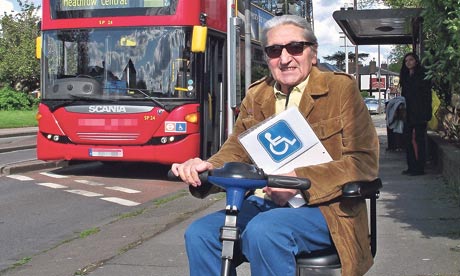
Ray Bellisario (pictured) has endured terrible treatment at the hands of some bus drivers.

Ray Bellisario in the 'offending' mobility scooter
However, people such as John Murphy who responded in an ill-informed way on Facebook do not help the situation:

"Ok everyone's saying poor this poor that, time to throw a spanner in the works, he could have arranged a private ambulance to his hospital appointment with ease, the bus drivers were following the correct procedures, after the wake of the 7/7 bombings they have to be more stringent when it comes to Health and Safety! Also they mobility scooters are a monstrosity to say the least, saying to sack the drivers for following the correct procedures just shows the ignorance surrounding this. 

He is also eligible to the mobility scheme! Which he can easily purchase a car from if not he can get it for his primary carer.

Again this is the PC police out in force as well."

To John Murphy, yes he could have opted for transport to the hospital, most London hospitals offer such a resource. However, arranging such transport is not at you put it, easy. When using this form of transport you often have to be ready to travel hours before your hospital appointment time. For people with chronic pain conditions, or for someone like me who has a neurogenic bladder, being without the means to use a toilet for more than 40 minutes creates a crisis.

Your contention that post-7/7 wheelchairs or mobility scooters, that fulfil the measurement criteria, are not allowed on buses is simply untrue. Calling an aid such as a mobility scooter a monstrosity, a piece of equipment that helps someone who cannot walk without great difficulty and pain, sums up your humanity.

Your knowledge of the Motability scheme is also lacking. In the first place you don't purchase the vehicles, they're leased for a three or five -year term; secondly how do you know he can afford to run the vehicle; and third, you are assuming the man in question has a primary carer.

Finally, I do agree to a some degree to your defence of drivers. Calling for people to be sacked in such circumstances is not always the most helpful way to go. Most bus drivers are decent people; and will go the extra to help out elderly and disabled passengers. Some, sadly fall short of proper disability awareness, and need training.

However, the answer to the problem of bad drivers lies with trade union organisation within the industry. Where there is poor organisation in garages you are more likely to have drivers who are intimidated by management and who will follow bad instructions and advice from managers whose only concern is the maximisation of company profits.

Therefore, the sooner we get 100% organised bus garages, especially in large conurbations such as London, the sooner we will see all drivers fully trained in disability awareness training. In fact we could go one better and bring the buses back into the hands of the public sector; bring back bus conductors and dignity for all travelling on our buses.  

Wednesday, 11 July 2012

Remploy Strike Details


Dear Comrade

As you are now aware the government has published a list of 27 Remploy factories it intends closing within the next few weeks. Our Comrades in Remploy would appreciate any and all support from sisters and brothers across the trade union movement, as well as people from their own communities.

The two dates for strike action already planned are Thursday 19th and Thursday 26th July. Though I don't have actual times of the actions (I imagine from 7.30 am to mid afternoon) I will get actual times out when I'm informed.

Please try to get to one, or more of the sites (see below for addresses) on the given days to show our Comrades in Remploy that they are not alone in this struggle; that their fight is indeed everyone of our fights.

Remploy Acton
2 Portal Way
Acton
London
W3 6RT

Remploy Barking
Long Reach Road
Barking
IG11 0JW

Unit 14
Crusader Industrial Estate
167, Hermitage Road
London
N4 1LZ

In Solidarity

Seán

Sunday, 8 July 2012

Remploy Workers Vote to Strike!


Remploy strike dates set, as ministers wield axe on 54 factories

Remploy workers faced with the dole queue are to stage two 24-hour strikes as the coalition gears up to close or sell-off the 54 factories that provide employment for disabled workers.

Unite, the largest union in the country, announced today (5 July) that its members will stage the strikes on Thursday, 19 July and Thursday, 26 July. A continuous overtime ban starts on Thursday, 12 July.

Remploy workers, members of the Unite and GMB unions, voted by large margins to take industrial action.

The workers are devastated by the coalition’s plans and have voted to strike because they believe the proposed closure negotiations were ‘a sham’; in protest at the intention to make disabled people compulsorily redundant for the first time at Remploy; and that the redundancy pay will be less than previous voluntary redundancies.

Unite members voted 59.7 per cent in favour of strike action and 76.1 per cent voted in favour of industrial action short of a strike.

The GMB members voted 79.5 per cent in favour of industrial action, including strike action and 87 per cent for action short of strike action.

Unite’s national officer for the not-for-profit sector, Sally Kosky said: “This vote for strike action demonstrates our members’ disgust at the way they have been treated by the government’s policies which are designed to throw them on the dole queue at a very difficult economic time.

“Work and Pensions Secretary, Iain Duncan Smith - the uncaring face of the coalition – has provoked this strike at Remploy by refusing to listen to the economic arguments. His decision is based on right-wing dogma.

“Our members are desperate to work in an environment that takes account of their disability and where they can make a valued contribution to society and pay their way.”

Phil Davies, GMB National Secretary, said: “The government's intention to destroy thousands of disabled workers jobs in Remploy has given rise to an overwhelming vote for strike action against the proposed closures of their 54 factories.

“These closures are going ahead without any consideration of the feelings and needs of these workers and their families or their future job prospects. To close a factory that employs disabled people in the present economic climate is a sentence to life of unemployment and poverty."

Unite and the GMB have been campaigning to keep the Remploy factories open as viable businesses and cite the recent upbeat assessment of Remploy’s future prospects from Alan Hill, Managing Director, Remploy Enterprise Businesses who wrote that: “We have grown our sales by 12.2%, a fantastic achievement.”

A total of 36 Remploy sites are due to close or be sold off in the near future, with the remaining 18 due to close or be sold-off next year.

The 27 factories where Unite has members can be viewed on the link: http://www.unitetheunion.org/remploynotforsale